Written by Vincent Hamann-Benoit (Trail Builder)
I was immediately captivated by the beauty of the place.
Was it because of the hundred-year-old trees, the majestic waterfall, the rugged terrain? All of that, yes. But also, remarkably, because of the fabulous carpets of moss. It covered the trunks, rocks and stumps, and in some places completely covered the ground. I was immersed in a world that reminded me of the old, mossy rainforests of Canada’s West Coast. It was early summer 2025, my first day of work at this place where I would help create the future trails of Burroughs Falls Park.
However, during the long weeks of drought that plagued the summer, the bright colours of the mosses, which I had marvelled at so much, faded. During this period, the magic of the place was somewhat diminished. Not only had the mosses faded, but except for those benefiting from particularly humid micro-sites, they had completely dried out. They were no longer fresh and spongy, but completely crispy.
One might have been tempted to believe that they had succumbed to the drought. How could such small plants have survived? But that was not the case. When the rains finally began to water the thirsty forest again in the autumn, the mosses came back to life. What a relief! The forest was once again adorned with its myriad shades of green.
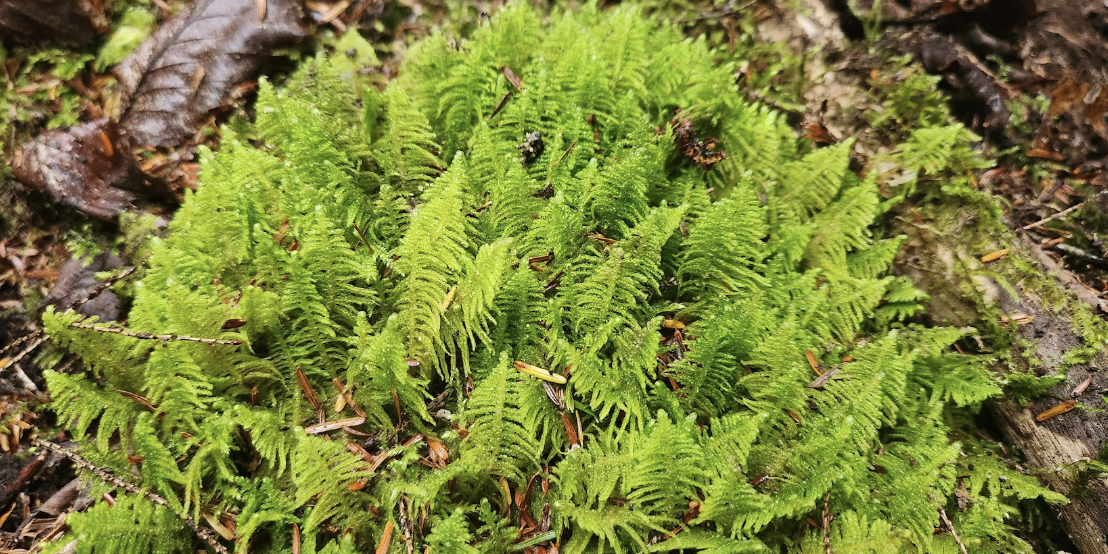
A carpet of different species of mosses colonising a rocky outcrop.
Photo credit: Vincent Hamann-Benoit (NB. All photos appearing in this article were taken at Burroughs Falls Provincial Park)
Exceptional drought tolerance
Mosses, the main representatives of the bryophyte group, are small plants that have the incredible ability to tolerate the desiccation of their tissues, i.e. water loss, without irreparable physiological consequences. Unlike vascular plants, which are the vast majority of plants we are most familiar with, such as trees, mosses are non-vascular plants, lacking roots and vessels for water absorption and transport. They are therefore unable to self-regulate their internal water content, which reflects external conditions. Most vascular plants lack this tolerance to desiccation and must maintain a stable internal water status at all times, otherwise they die. This is not the case for mosses, which simply enter a period of dormancy. These are two completely different evolutionary strategies.
| Miraculously, mosses can resume photosynthesis as soon as moisture returns, in just 25 minutes (10). |
Extreme habitats
Equipped with this resistance to desiccation, mosses tend to colonise exposed surfaces with harsh conditions where vascular plants cannot grow. Almost any surface is suitable, provided that its texture allows their rhizoids, root-like organs that cannot absorb water or minerals, to anchor themselves. Moisture, in one form or another, must also be adequate. Examples include rocks, tree trunks, wood debris, building foundations and even some roofs. As you will notice, these surfaces are often vertical!
| Old trees: preferred habitats
The trunks of older trees, and those with higher pH bark, seem to be associated with a greater abundance and diversity of mosses (4). In the southern part of Quebec’s boreal forest, older forests are associated with greater moss diversity, with some species found exclusively there (1). |
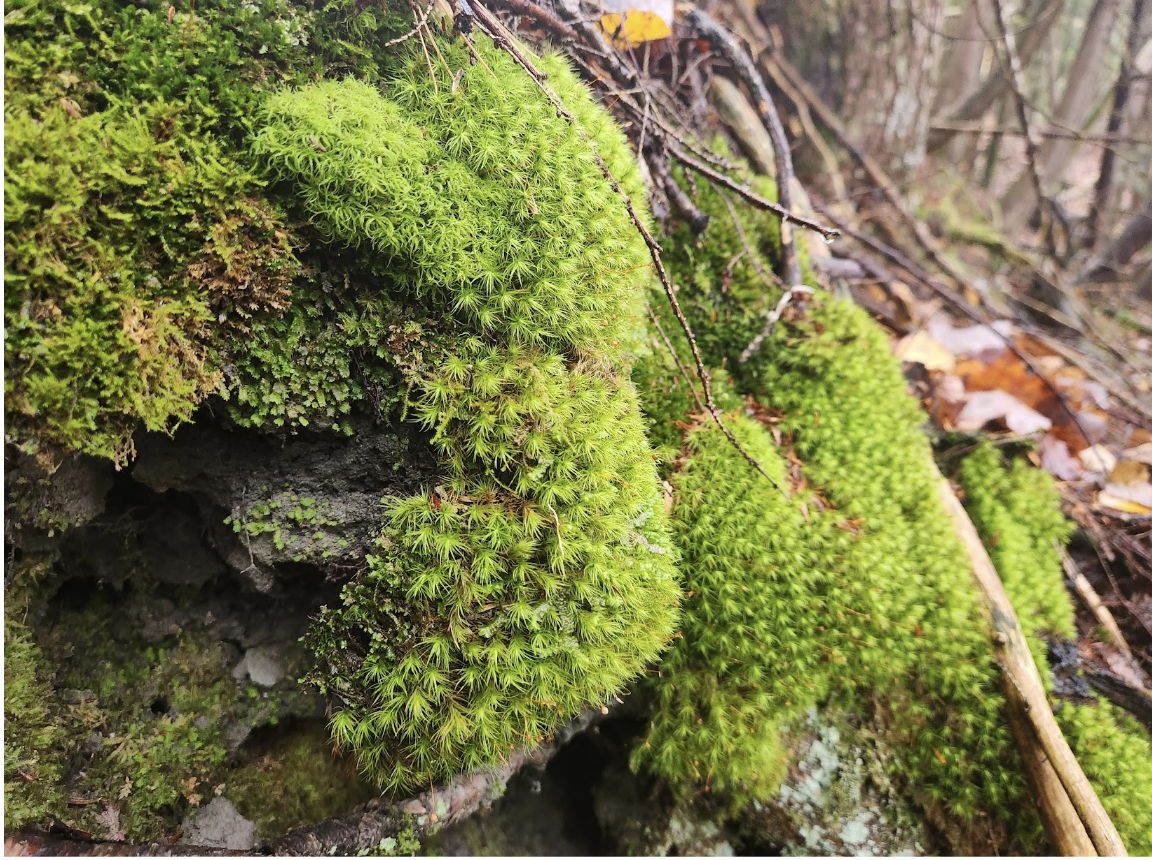
Feather moss, a species of moss associated with mature forests (7). Photo credit: Vincent Hamann-Benoit
Using a specialised chlorophyll arsenal, certain moss species are able to thrive in heavily shaded environments, where ambient light levels can be as low as 5%, which is insufficient for most vascular plants (10). As a result, mosses often dominate the forest floor in dense coniferous forests, such as certain hemlock stands in Burroughs Falls Provincial Park.
The forest floor of deciduous forests, with its annual renewal of thick leaf litter, is simply not conducive to the growth of mosses, which would be buried due to their small size. Therefore, vascular plants, which are more competitive in these conditions, generally dominate the understory. In these environments, mosses therefore stick to upright structures: tree trunks, rocks and woody debris.
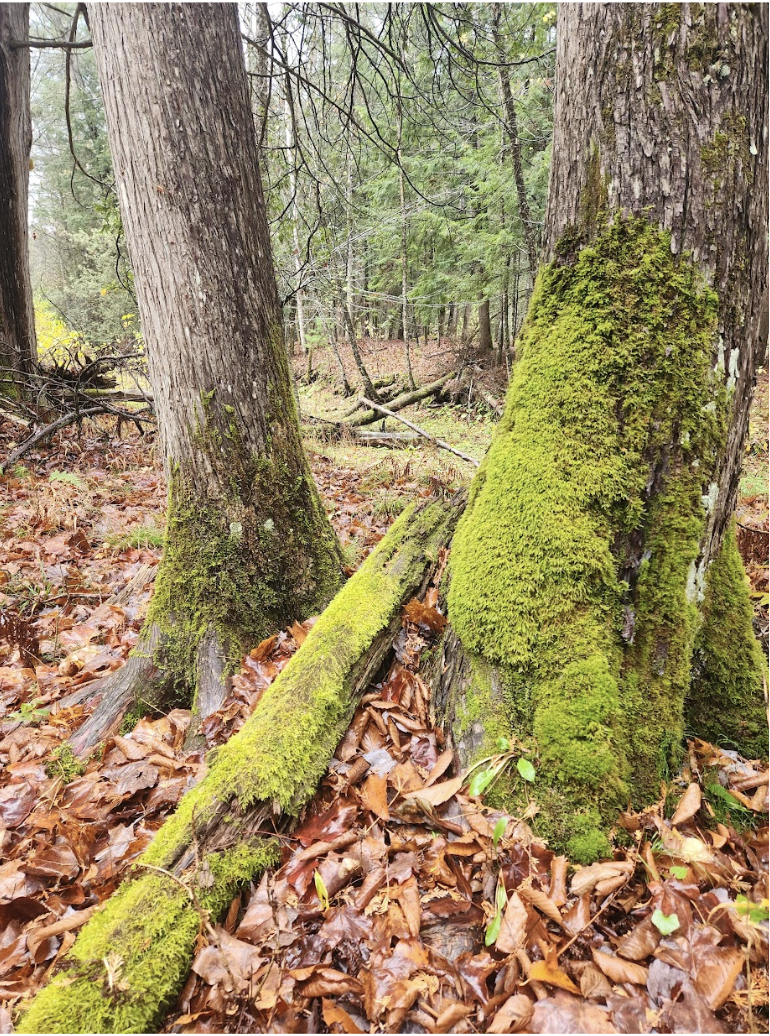
Tree trunks and woody debris colonised by mosses. Photo credit: Vincent Hamann-Benoit
Real sponges
Thanks to the arrangement of their leaves and stems, mosses excel at absorbing and retaining water droplets, whether they come in the form of rain or mist. They are veritable sponges.
| Mosses can absorb up to several hundred times their weight in water (8). |
Thus, in ecosystems where they are abundant, mosses can capture a significant portion of the rain and slowly release it to the rest of the ecosystem. This dynamic gives them essential ecological roles, including reducing runoff and regulating the water cycle (3, 8, 10). As a result, mosses can mitigate the risks of drought and forest fires (3, 8, 10).
| Cosy nests
The structure that makes mosses act like sponges also gives them a characteristic that is attractive to birds: they are excellent thermal insulators. For this reason, and because they have antimicrobial properties, mosses are used by several species, such as the black-capped chickadee and the common wren, to line their nests, making them cosy and healthy for their young (6). If you keep your eyes peeled in spring, you may spot a sprig of moss hanging from the beak of a parent bird busy building its nest. |
Miniature forests
Mosses harbour impressive ecosystems within their structure. These include nitrogen-fixing cyanobacteria, algae, fungi and numerous insects and other invertebrates (2, 6). Certain plant species find an ideal germination bed there, as mosses can act as veritable nurseries (10). They are often compared to miniature forests, and it is worth taking a close look at them with a good magnifying glass. You are sure to be amazed!
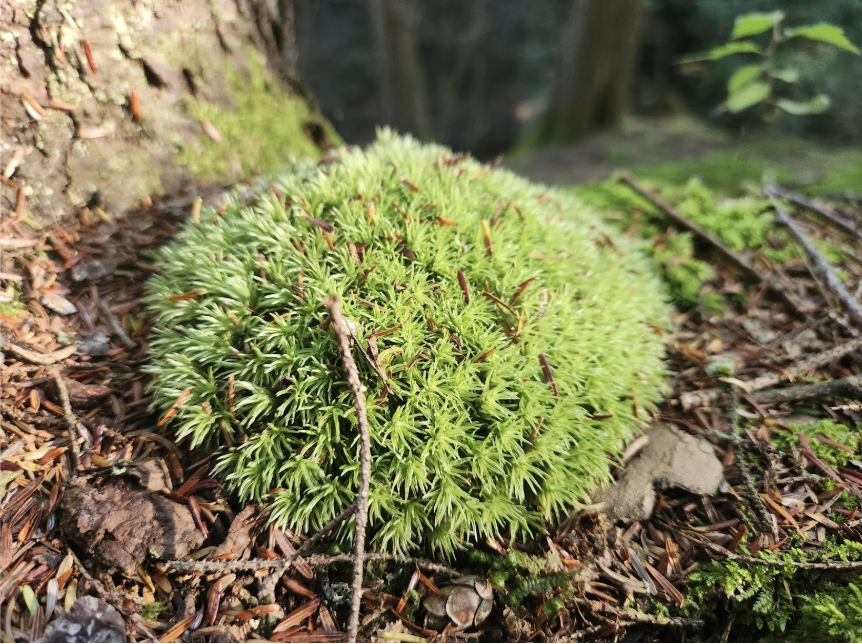
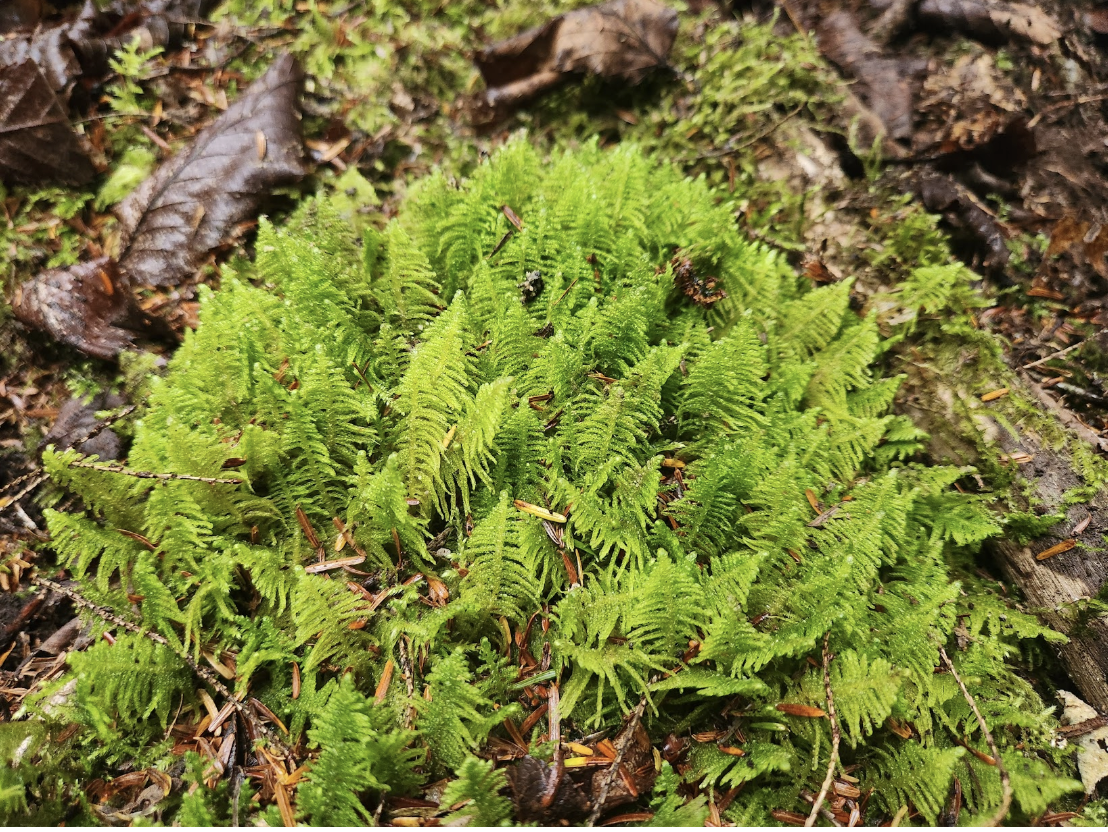
A single colony of wood cushion moss, a species of moss that grows directly on the ground, can reach 1 m in diameter after several decades (7). Photo credit: Vincent Hamann-Benoit.
| An impressive diversity!
According to the database of the Société québécoise de bryologie, there are nearly 700 species of moss in Quebec (9), 128 of which are likely to be designated as threatened or vulnerable (5). |
An ideal habitat
With its dense hemlock forests, old trees, abundance of woody debris and rocks, numerous streams, a huge waterfall producing constant mist, and rugged terrain creating several shaded areas protected from drying winds, Burroughs Falls Park has several features that allow mosses to thrive.
Fortunately, since 2023, the park has enjoyed perpetual protection status. It is now up to us, the users of the site, to contribute to the preservation of this fabulous ecosystem by adopting behaviours that allow mosses to continue to thrive. For although they are incredibly resilient, mosses are also fragile plants that grow slowly and sometimes discreetly.
How can we take care of mosses?
– By taking an interest in them and learning about them (sign up for an introductory workshop on bryology, buy a book on mosses, carry a magnifying glass with you when you go to the forest)
– Stay on designated paths to avoid trampling them
– By avoiding transplanting them – an operation that is often doomed to failure
– By refraining from picking them and instead admiring them where they grow
References
- Boudreault, C., Gauthier, S., & Bergeron, Y. (2000). Epiphytic Lichens and Bryophytes on Populus tremuloides along a Chronosequence in the Southwestern Boreal Forest of Québec, Canada. The Bryologist, 103(4), 725–738. http://www.jstor.org/stable/3244336 (The role of mosses in the ecosystem).
Fenton, N. (2025). Mosses, plants essential to the biodiversity of our forests. Interview broadcast on Place Publique, 1 August 2025. Radio-Canada OHdio. Available at: https://ici.radio-canada.ca/ohdio/premiere/emissions/place-publique/segments/rattrapage/2141423/connaissez-vous-role-mousse-qui-couvre-sol-en-foret.
Fenton, N. (2024). Moss, the miniature forest essential to ecosystems. Column broadcast on the programme Moteur de recherche, 20 June 2024. Société Radio-Canada. Available at: https://ici.radio-canada.ca/ohdio/premiere/emissions/moteur-de-recherche/episodes/791114/rattrapage-jeudi-20-juin-2024.
Fritz, Ö., Brunet, J., & Caldiz, M. (2009). Interacting effects of tree characteristics on the occurrence of rare epiphytes in a Swedish beech forest area. The Bryologist, 112(3), 488-505.
Government of Quebec. (2025). List of threatened or vulnerable plant species. Available at: https://www.quebec.ca/agriculture-environnement-et-ressources-naturelles/flore/especes-floristiques-menacees-ou-vulnerables/liste-especes.
Kimmerer, R. W. (2003). Gathering moss: A natural and cultural history of mosses. First edition. Oregon State University Press. 178p.
Ministry of Natural Resources and Forestry. (2023). Petite flore forestière du Québec. 3rd revised and expanded edition. Collective work supervised by N. Dignard. Québec, Les Publications du Québec. 430p.
Slate, M. L., Antoninka, A., Bailey, L., Berdugo, M. B., Callaghan, D. A., Cárdenas, M., … & Coe, K. K. (2024). Impact of changing climate on bryophyte contributions to terrestrial water, carbon, and nitrogen cycles. New Phytologist, 242(6), 2411-2429.
Société québécoise de bryologie. (2025). Bryoquel. The database of bryophytes of Quebec – Labrador. Available at: https://societequebecoisedebryologie.org/Mousses.html.
Ward, A. (2019) Bryology (moss) with Dr. Robin Wall Kimmerer. Ologies with Alie Ward. Available at: https://www.alieward.com/ologies/bryology.